40 Jeffery, p. 312. In fact, the agent had the information from close friends in the East Prussian aristocracy, who had met the German negotiators on a social visit, during which they had spoken freely.
41 Jeffery, pp. 372–3.
42 Jeffery, pp. 192–3.
9 Between the Hammer and the Anvil
1 It involved tens of thousands of fighters, pitched battles, networks of underground bunkers, elaborate command structures, education and welfare systems, propaganda newspapers and a parallel justice system. The historian Joseph Pajaujis-Javis lists the Lithuanian partisans’ goals as: (1) To prevent Sovietisation of the country by annihilating communist activists and the KGB forces in the countryside; (2) to safeguard the public order, to protect the population from robberies, either by civilians, or by Red soldiers; (3) to free political prisoners from detention wherever circumstances allowed it; (4) to enforce the boycott of the ‘elections’ to the Supreme Soviet of the USSR or to the leadership of the puppet state, and thus to prevent the falsification of the will of the Lithuanian nation and the creation of a false base for the legality of the Soviet-imposed regime; (5) to disrupt the draft of Lithuanian youth into the Red Army; (6) to obstruct the nationalisation of landed property and collectivisation of agriculture; (7) to prevent the settling of Russian colonists on the land and in the homesteads of the Lithuanian farmers deported to Siberia. From Soviet Genocide in Lithuania (Manyland Books, New York, 1980), p. 95, quoted (p. 24) in ‘Forest Brothers from the West’ by Darius Razgaitis (Boston University thesis 2002) available at http://www.mrdarius.com/fb/wfd.pdf
2 A Tangled Web: The memoirs of an Estonian who fell into the clutches of MI6 and the KGB by Mart Männik, translated and introduced by the Earl of Carlisle (Greif Grenader Publishing, Tallinn, 2008) p. 50. http://www.scribd.com/doc/50728582/Mart-Mannik-A-Tangled-Web
3 Quoted in The Last Ambassador by Tina Tamman (Rodopi, 2011), p. 176.
4 See The War in the Woods by Mart Laar (Compass Press, 1992), p. 207.
5 The partisan leader was Algirdas Vokietaitis; the intermediary was the Lithuanian diplomat and later SIS agent Vladas ‘Walter’ Žilinskas. See Pavargęs herojus, Jonas Deksnys trijų žvalgybų tarnyboje (The Weary Hero: Jonas Deksnys in the Service of Three Intelligence Agencies) by Liūtas Mockūnas (Baltos Lankos, Vilnius, 1997), p. 138. See also Razgaitis, p. 17. This is earlier than the 1947 date given by Jeffery. Mart Laar’s book states (p. 208) that contact was re-established between SIS and the Lithuanian partisan movement in the ‘spring of 1945’. A lengthy KGB history written by Lukaševičs in 1986 gives the date as March 1943.
6 See Toomas Hellat ja KGB (Toomas Hellat and the KGB) by Tõnis Ritson http://riigi.arhiiv.ee/public/TUNA/Artiklid_Biblio/RitsonTonis_Toomas_Hellat_1_TUNA1998_1.pdf
7 Having originally felt themselves buttressed by a British naval presence in the Baltic Sea and by the League of Nations’ pledge to protect small countries, the Baltic states found they had to look out for themselves. France and America were far away; Britain, having pulled out of the Baltic under a deal with Germany in 1935, was no longer to be trusted. The three small countries tried permutations of friendship with Poland, Sweden, Germany and the Soviet Union, as well as an abortive Baltic entente. None of it worked.
8 Timothy Snyder’s book Bloodlands: Europe between Hitler and Stalin (Basic Books/Bodley Head, 2010) is an incomparable account of the wider picture of mass murder: www.bloodlandsbook.com
9 A shortlived Estonian government under the lawyer Otto Tief, for example, took power as the Nazis withdrew in 1944. Those of its members who could not escape were jailed. One, Arnold Susi, befriended Aleksandr Solzhenitsyn in a prison camp. In The Gulag Archipelago, Solzhenitsyn wrote:
[Susi] breathed a completely different sort of air. And he would tell me passionately about his own interests, and these were Estonia and democracy. And although I had never expected to become interested in Estonia, much less bourgeois democracy, I nevertheless kept listening to his loving stories of twenty free years in that modest, work-loving, small nation of big men whose ways were slow and set. I listened to the principles of the Estonian constitution, which had been borrowed from the best of European experience, and to how their hundred-member, one-house parliament had worked. And, though the ‘why’ of it wasn’t clear, I began to like it all and store it all away in my experience.
I listened willingly to their fatal history: the tiny Estonian anvil had, from way, way back, been caught between two hammers, the Teutons and the Slavs. Blows showered on it from East and West in turn; there was no end to it, and there still isn’t. (Harper & Row edition, 1974, p. 242.)
10 Laiškai Mylimosioms (Letters to Loved Ones) (American Foundation for Lithuanian Research, 1993), p. 10; quoted in Razgaitis, p. 20. Some had until recently been in German uniform: many Estonians and Latvians had joined (or were conscripted into) the Third Reich’s military. In a perverse bit of branding (non-Germans were not allowed to join the ‘real’ German army, the Wehrmacht), these were enlisted under the Waffen-SS logo. Though some had previously been in police and other units involved in the Holocaust, others were guilty only of being on the wrong side of history. The units have been confused with Hitler’s gruesome Schutzstaffel, originally the paramilitary wing of the Nazi Party. The US Displaced Persons Commission in September 1950 declared that ‘The Baltic Waffen SS Units (Baltic Legions) are to be considered as separate and distinct in purpose, ideology, activities, and qualifications for membership from the German SS, and therefore the Commission holds them not to be a movement hostile to the Government of the United States.’
As the post-war Stalinist terror intensified, the regime’s tactics became ever more cynical and brutal. The authorities repeatedly offered amnesties, but those who tried to take advantage of them were imprisoned, tortured, deported or forced to fight on the other side. Staying on the sidelines was all but impossible. Those who refused to inform on their colleagues, families and friends were themselves suspect. Taking up arms offered at least the chance of a more glorious death.
11 Bower, p. 59–60. The later cover for the operation was the British Baltic Fishery Protection Service, based in Kiel in the British zone of Germany, and using two souped-up German Lursen E-Boats. The crew were German; the captain, Hans Helmut Klose, later became the commander-in-chief of the West German navy.
12 The genuine movement was called VLIK – Vyriausiasis Lietuvos išlaisvinimo komitetas (Supreme Committee for the Liberation of Lithuania). The Soviet-sponsored one was VLAK – Vyriausiasis Lietuvos atstatymo komitetas (Supreme Committee for the Restoration of Lithuania). Many working for VLAK initially did not realise that it was bogus. The KGB provided flawless forged papers for its unwitting emissaries when they visited the West. Genuine partisans later made three attempts to kill the VLAK leader Markulis, until the KGB took him to a safe house in Leningrad.
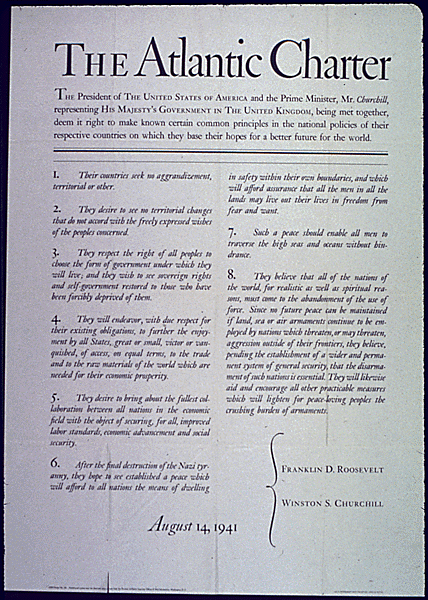
13 Partizanai Apie Pasaulį, Politiką ir Save (Partisans on the World, Politics and Themselves), ed. Nijolė Gaškaitė-Žemaitienė (Genocide and Resistance Studies Center, Vilnius, 1998), p. 95, quoted in Razgaitis, p. 30. The men and women involved in the struggle displayed a determination and optimism that can seem almost delusional to the outsider. Perhaps naively, few in the region imagined the West and the Kremlin would let the countries snuffed out by the dictators’ pact of 1939 be the biggest losers of the post-war settlement. They took at face value the words of the Atlantic Charter: self-determination for all, and that ‘territorial adjustments must be in accord with the wishes of the peoples concerned’ http://www.archives.gov/education/lessons/fdr-churchill/images/atlantic-charter.gif