Аннотация
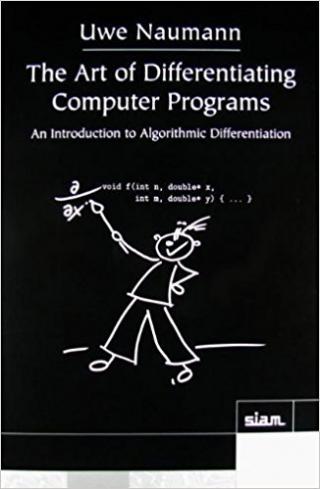
This is the first entry-level book on algorithmic (also known as automatic) differentiation (AD), providing fundamental rules for the generation of first- and higher-order tangent-linear and adjoint code. The author covers the mathematical underpinnings as well as how to apply these observations to real-world numerical simulation programs.
Readers will find
• many examples and exercises, including hints to solutions;
• the prototype AD tools dco and dcc for use with the examples and exercises;
• first- and higher-order tangent-linear and adjoint modes for a limited subset of C/C++, provided by the derivative code compiler dcc.
• a supplementary website containing sources of all software discussed in the book, additional exercises and comments on their solutions (growing over the coming years), links to other sites on AD, and errata.
Audience
This book is intended for undergraduate and graduate students in computational science, engineering, and finance as well as applied mathematics and computer science. It will provide researchers and developers at all levels with an intuitive introduction to AD.


![Python 3.4 introduced the asyncio library, and Python 3.5 produced the async and await keywords to use it palatably. These new additions allow so-called asynchronousprogramming.
All of these new features, which I’ll refer to under the single name Asyncio, have been received by the Python... Using Asyncio in Python [Understanding Python’s Asynchronous Programming Features]](https://www.rulit.me/data/programs/images/using-asyncio-in-python-understanding-python-s-asynchronous_606937.jpg)


![The C programming language has been around for a long time — the canonical reference for it is the book written by its creators, Kernighan and Ritchie [1978]. Since then, C has been used in an incredible number of applications. Programs and systems written in C are all around us: in personal... Modern C](https://www.rulit.me/data/programs/images/modern-c_609369.jpg)
Комментарии к книге "The Art of Differentiating Computer Programs: An Introduction to Algorithmic Differentiation"