The aim of the mine rescue training was to teach the divers about the overall forces they would be up against, arming them with the kind of clear-eyed, fact-based knowledge they could use in a crisis to counteract all the emotion that would be coursing through them. The trainer explained how, when confronted with extreme danger and stress, a person’s fight-or-flight response kicks in, producing a flood of stress hormones, notably cortisol and adrenaline. This produces short-term benefits, sending more oxygen to the brain to fight off the threat. But the price for this response is a huge spike in the consumption of oxygen. During the Drager training, the divers had been tutored on how to use their backup air supplies. In addition to the rebreathers, there were self-rescuer devices called Ocencos, which were designed to give up to sixty minutes of air, and a Drager “bail-out,” a small bottle that the divers would wear on their hips, offering up to ten minutes of emergency air. However, the trainer explained that in a crisis, with the fight-or-flight response gobbling up all that additional oxygen, those backup supplies would run out of air in about half the usual time. So an apparatus promising sixty minutes of air could be counted on for just thirty.
All that adrenaline might give the divers the strength to do things they never thought possible. However, the trainer cautioned, the divers needed to respect their limits. “Don’t try to bluff your way through116,” the training manual warned. “Feeling nauseous with your apparatus on is just not safe. If you are in unsafe air and you vomit into your facepiece, you will not be able to take off your facepiece.... If you pass out or go down, you become a detriment to your team.”
For DJ, the most sobering lesson in the mine rescue training was the one that focused on how to handle a fallen comrade. Notwithstanding that scenario about having to choose between your partner and a six-year-old boy, the awful message from the trainer was that, in a confined space like a mine or an endless, empty sewer tunnel, the divers probably would have no choice at all. If disaster struck and took a team member down, the other divers’ main task had to be to ensure their own safe exit, rather than risk becoming another casualty by trying to revive their coworker or retrieve the body. One handout put it this way: “If the victim has collapsed as a result of an oxygen deficient atmosphere and been there for any length of time, it is very likely that he is dead and the discoverer’s life is risked in vain.”
To DJ, this seemed to go against what he had learned as a diver, where the expectation was that you’d do everything in your power to try to save your buddy. And it certainly violated the Saving Private Ryan message of duty and honor that he had gleaned from watching hours of World War II movies and documentaries.
But the trainer stressed that the tunnel’s irrespirable air made it more hazardous than a battlefield. In an environment where just one or two breaths could be fatal, the main tenet in an emergency situation had to be: “Do no more harm.” A mine rescue association117 had compiled numbers from mine disasters over the last half century and found that, despite their good intentions, people attempting to save miners had ended up losing their own lives at a rate that increased the total number of casualties by about 50 percent. The message to the divers was clear. You must not add to the body count.
In mine disasters, a special rescue and recovery team is typically responsible for retrieving bodies, after safe passage has been established. DJ winced at the graphic descriptions in the training manual118, such as the one warning recovery team members how careful they had to be in handling bodies that might have decomposed: “In some cases, the skin has actually been pulled off the hand and resembles a hand-like glove, complete with fingernails and creases at the knuckles.”
While the tunnel mission would be different from a mine operation, there would be enough Black Dog and Norwesco divers hired and trained to allow for a separate backup crew. Those divers would remain on standby anytime the main team was working in the tunnel. But exactly how and under what circumstances that backup crew would be activated remained unclear.
Everything boils down to oxygen. Human life depends on it. Yet oxygen makes up just 21 percent of the air humans normally breathe. By far the biggest component is nitrogen, at 78 percent (with the remaining 1 percent made up of other gases). But that big dose of nitrogen is inert, meaning it’s just along for the ride. It does nothing to support human breathing119 and becomes a factor only in the negative, if it somehow becomes an asphyxiant by displacing the amount of available oxygen. Although oxygen makes up just one-fifth of our breathing air, when the usual concentration slips even slightly, bad things begin to happen.
The mine rescue trainer had the divers flip to a printed table in their manual, which spelled out the dire consequences of falling oxygen concentration120.
17 percent: Panting, decreased ability to perform tasks
15 percent: Tightness in forehead, headaches, dizziness, impaired judgment
9 percent: Unconsciousness
6 percent: Death
The trainer explained that the most insidious part of oxygen deficiency is that the sufferer is typically not aware of what’s happening until it’s too late.
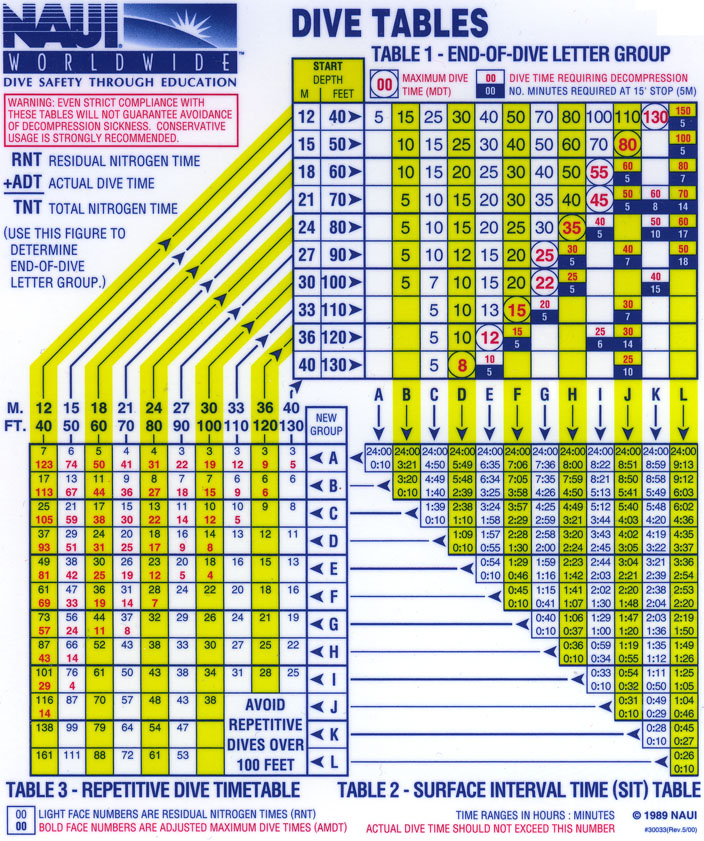
For DJ and the other divers, number-dense charts were nothing new. One of their early lessons in dive school had dealt with how to read the tables in the U.S. Navy Diving Manual. These spelled out the appropriate number of decompression stops they’d have to make on a dive, based on depth, and the total time they’d need to spend breathing oxygen in a chamber to decompress. Deep-sea divers had to understand and respect these numbers if they were to avoid complications or even death. The two biggest concerns were121 decompression sickness, or “the bends,” which can cause paralysis if divers ascend too quickly; and nitrogen narcosis, which produces a feeling of intoxication and slows mental functioning. Divers often refer to the effects of narcosis as Martini’s Law, which holds that, for every fifty-foot depth, a diver is hit with the anesthetic equivalent of drinking one martini. Both of those were nitrogen-related dangers, however. Surprisingly, when it came to oxygen, commercial divers on deep dives typically had to be more concerned about getting too much oxygen rather than too little. Astronauts have no problem breathing pure oxygen before and during spacewalks, since that helps reduce the nitrogen levels in their tissues. But for divers working underwater, oxygen is not necessarily their friend. That’s because the deeper the divers descend, the more they must contend with the increasing pressure from above. For every thirty-three-foot descent in salt water, divers carry the pressure of one additional “atmosphere”—that is, the total weight of all the air above ground. Deep-sea divers know that they must breathe higher concentrations of oxygen to counteract that increased partial pressure. But elevated oxygen levels can quickly become toxic, potentially leading to convulsions or seizures.
On this job, although the divers would be working hundreds of feet below the sea, the tunnel walls would protect them against pressure. So they wouldn’t have to worry about too much oxygen, only too little.
116 (Chapter 5, note 16)
“Don’t try to bluff your way through”: U.S. Department of Labor, Mine Safety and Health Administration (MSHA), “Mine Rescue Training Module,” West Virginia University Mine Extension Service, 18. I obtained from DJ the actual copy that he used during the training in New Hampshire.
117 (Chapter 5, note 17)
A mine rescue association: Rob McGee, “Miners Killed During Recovery Operations,” U.S. Mine Rescue Association, Uniontown, Pennsylvania, www.usmra.com/rescuer_deaths.htm.
118 (Chapter 5, note 18)
graphic descriptions in the training manuaclass="underline" MSHA, “Mine Rescue Training Module,” 15.
121 (Chapter 5, note 21)
The two biggest concerns were: Dr. Marie E. Knafelc, interviews by author; Christopher Swan,